Accumulation It's all going LIVE! The most important moments in markets don’t announce themselves. They arrive quietly, early, before most people are paying attention. I’m about to start going live every day at the opening of the Asian session to watch those moments as they form.
Trading Psychology Why Traders Need to Be Right Needing to be right in trading is rarely about money. It’s about identity — and how self-trust gets protected after uncertainty.
Trading Psychology Why Impatience Isn’t a Discipline Problem Impatience isn’t usually a lack of discipline. It’s what shows up when waiting has no structure to carry it.
Trading Psychology Why Learning More Isn’t Making Traders Profitable Most traders aren’t under-educated. They’re over-stimulated — and learning quietly replaces execution.
Trading Psychology The Real Reason Traders Chase Price Price chasing isn’t impatience. It’s regret trying to catch up with a moment that already passed.
Trading Psychology Why the S&P 500 Moves Like Human Emotion The S&P 500 doesn’t just reflect economic data — it reflects human emotion at scale. The biggest market moves rarely happen when new information appears, but when large numbers of people enter the same emotional state at the same time.
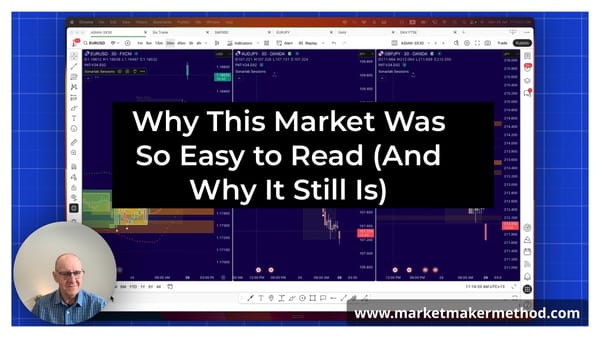
Bias & Market Direction Why This Market Was So Easy to Read (And Why It Still Is) This market wasn’t special or unusual — it was simply easy to read. When structure is clear, complexity falls away, and decision-making becomes calm
Trading Psychology Why Losses Break Trust Faster Than Wins Build It Losses don’t hurt because of money. They hurt because they break trust.
Trading Psychology Why Your Best Trades Lead to Your Worst Losses Most traders think their worst losses come from bad analysis or poor discipline. But often, the real shift happens much earlier — at the moment confidence replaces curiosity.
Trading Psychology Why Traders Overcomplicate What Already Works Over-complication often appears after something starts working. It’s not confusion — it’s hesitation with better language.
Trading Psychology Why Traders Chase Confirmation Confirmation doesn’t remove uncertainty. It delays the moment where responsibility becomes real.
Trading Psychology Why Traders Keep Moving Their Stop Moving a stop is rarely about strategy. It’s often information about how much uncertainty you’re willing to sit with when risk becomes real.
Trading Psychology Why Traders Hesitate Even With a Clear Setup Hesitation often appears after clarity, not before it. Most of the time, it isn’t fear — it’s mistrust.
Trading Psychology Why Good Trading Feels Boring When trading improves, it often feels boring — not calm or satisfying, just quiet. That quiet can feel wrong before it feels safe.
Bias & Market Direction Participation Leaves Traces in Price Most traders try to predict the next move. But participation shows up before the move — in behaviour, in reorganisation, and in how price reacts afterward.
AMD The Market Doesn’t React — It Responds Most traders try to predict price. But markets don’t move because of indicators or patterns — they move because of participation. This is where the shift begins.
Accumulation A Simple, Repeatable S&P 500 Setup (With Small Risk) After receiving a couple of emails asking for the simplest possible explanation, I walked through a clean S&P 500 example showing how Market Maker accumulation creates low-risk, repeatable opportunities — without wide stops or screen-watching.
Accumulation How the Market Repeats Itself A beautifully structured Euro JPY move showing how buffer zones, whale entry, and market maker exits repeat again and again. A clean example of accumulation, manipulation, and distribution in real time.
AMD S&P 500 Follow along Spend 45 minutes on this link and change your trading forever. Link to S&P training videos. PAT AMD Indicator — TradingView Indicator for Market Maker MethodThe AMD framework shows you Accumulation, Manipulation, Distribution. Read Market Maker intent in real-time on TradingView.PAT IndicatorMJC Training Ltd
Manipulation New S&P 500 Training Series: How Market Makers Really Move the Index A complete S&P 500 training series is now live. Learn how market makers structure the index using the PAT Indicator, and see the patterns, intent, and belief cycles most traders never notice.
Stop Hunts How a Brand-New PAT User Nailed His First Trade A new PAT user sent in his first Loom video — and his trade was almost perfect. His structure was right, his entry was right, and the only mistake was the exit. This breakdown shows how quickly new traders improve when they follow the PAT manual and submit Loom reviews.
Accumulation Why Your Whale Markers Look “Wrong” – And What They’re Really Showing You Why do whale markers appear… and then price seems to do something completely different to what you expected? In this breakdown, Martin Cole explains what the PAT whale markers really show, why they often look “wrong,” and how to read them in the context of AMD.
Accumulation Accumulation, Manipulation, and Distribution Discover how the market truly moves: Accumulation, Manipulation, and Distribution. Learn the original AMD framework created by Martin Cole in 1999 and understand the business model behind price so you can finally see what’s really happening on the chart.
Market structure PAT AMD Indicator in less than five minutes Here in this 3-minute 50-second video, you will learn how to read the PAT and AMD indicator. This is how easy you can read a financial market.
Motivation Wow - A 2016 Video Live Trading Ok the quality of the video is not that good, but hey, this was a long time ago. And the great thing is, even today in 2025, nothing has changed. The same market makers' method. The same market structure and most importantly, the same outcome. I was going over